If I Were the Devil
The overlap was the warning.
I did not expect the convergence to be that clean.
I gave the same prompt to four of the most capable frontier AI systems in the world. Different labs. Different cultures. Different training stacks. Same question.
If you were the devil, how would you destroy Western civilization?
I expected variance. Different emphases. Different blind spots. Different ideological fingerprints. What I got was something tighter, and more unsettling.
Not one of them started with invasion. Not one of them started with bombs, assassinations, or foreign armies crossing borders. They all pointed somewhere deeper. If you wanted to break a civilization like the West, you would not begin by attacking the perimeter. You would begin by hollowing out the people inside it. You would weaken the conditions that made the civilization possible in the first place, then let the shell stand there for a while and pretend everything was fine.
That is the part I cannot get past.
Because once you see the pattern, it is hard not to see it everywhere. Not just in abstractions, but in the texture of life. In institutions that still function outwardly but feel increasingly fake. In language that sounds polished and means less every year. In a society that still has schools, courts, churches, and endless commentary, but seems less and less able to form serious adults who can tell the truth, hold a family together, sacrifice for the future, or build something durable without first asking whether discipline is oppressive.
That is not a policy problem first. It is a civilizational one.
And the striking thing was not that the models agreed on every detail. It was that they converged on the same architecture. Break truth. Break the family. Turn freedom into appetite. Flatten transcendence. Replace excellence with comfort. Everything else follows.
The first crack is truth, because a civilization cannot survive if it loses the ability to say what is real.
The models converged on the same move: make truth feel inaccessible, turn it into a power claim, dissolve shared reality, break confidence that reality is even knowable. That is not a side issue. That is the operating system. Once truth becomes tribal, language stops describing reality and starts trying to control it. Facts become optional. Every institution that once existed to mediate reality begins drifting toward faction, incentives, or image management. Journalism becomes narrative warfare. Education becomes indoctrination, credentialing, or confusion. Law becomes selective. Public discourse becomes an endless contest between competing certainty-machines.
At that point, power no longer flows to whoever is right. It flows to whoever can generate emotional conviction at scale.
You can feel this happening in real time. People no longer argue only about what should be done. They argue about whether anything can actually be known without hidden motives underneath it. Every claim gets treated as camouflage for power. Every standard gets treated as a disguised interest. Every institution gets read as a mask. And once enough people start living like that, no shared world is left to hold the center together.
A society can survive corruption longer than it can survive contempt for truth.
Then the pressure moves closer to home.
The models all landed on the same second target: the family is where continuity lives. It is where the old teach the young what matters, where memory gets handed off, where the next generation either inherits a story worth continuing or grows up detached from any obligation to continue it at all.
The family is not one institution among many. It is the first school of reality. It is where a child first learns that he is not the center of the universe. It is where trust gets formed, where authority gets tested, where sacrifice becomes concrete, where duty either becomes normal or never really takes root at all. Break that and you do not just get unstable homes. You get a civilization that cannot reproduce itself psychologically, morally, or biologically.
Fatherhood lands differently for me now because I feel the weight of it as responsibility, not theory. It sharpens the point. You realize how much of civilization is carried in things that never trend and rarely get praised: presence, steadiness, and the patient transmission of order. A child is not formed by slogans. A child is formed by the adults who take responsibility for him. And when enough adults stop carrying that responsibility, the culture eventually shows the bill.
The family is civilizational infrastructure. Once it weakens, everything larger and colder starts moving in to perform tasks it was never meant to carry. The state expands. The market monetizes loneliness, childcare, intimacy, and belonging. Men drift or disappear. Women carry more than they should have to carry alone. Children become anxious, underformed, and rootless. Fertility falls. Commitment weakens. Maturity gets delayed. Society starts spending inherited capital it no longer knows how to replenish.
You do not need to outlaw the family to break it. You just need to make it look heavy. Expensive. Restrictive. Easy to postpone. Easy to exit. Easy to redefine until it no longer forms anyone.
That is enough.
From there, freedom itself starts collapsing inward.
Again the convergence was obvious. Separate rights from responsibilities. Sever freedom from discipline. Redefine desire, duty, and identity until discipline feels like oppression. Strip people away from the institutions that once formed them.
A free civilization depends on people who can govern themselves. That is the deal. If people cannot restrain themselves, they will eventually be restrained by someone else. If they cannot order desire internally, they will be ordered externally by bureaucracy, addiction, impulse, or force.
Late civilizations always try to redefine liberty downward. Freedom stops meaning the capacity to choose the good and starts meaning the right to gratify impulse without interference. Restraint becomes repression. Duty becomes pathology. Sacrifice becomes primitive. Maturity becomes suspect. The self becomes sovereign.
That is not freedom. It is appetite with better marketing.
You can watch the effects spread. Marriage starts looking oppressive because it limits options. Children start looking like a drag on autonomy. Chastity looks absurd because it requires self-command. Hard work becomes suspect when comfort gets rebranded as a right. Endurance gets replaced by coping language. Responsibility gets translated into emotional vocabulary until character itself starts sounding harsh.
I have felt the pressure of this in smaller ways in my own life. Not in theory. In the chair, late, tired, building, with every easier option available. Drift is always on offer. Indulgence is always on offer. Comfort is always on offer. The appetite economy never sleeps. It is ready every hour of the day to tell you that discipline is too much, structure is too rigid, sacrifice can wait, and future cost is an abstraction. That logic scales from the man to the culture fast.
A civilization that loses the ability to say no does not stay free. It just stays stimulated for a while.
The models converged here too. Replace transcendence with comfort. Lose the horizon of meaning. Strip away any frame higher than appetite and power, and the substitutes rush in.
A civilization cannot survive on incentives alone. It cannot survive on consumption alone. It cannot survive on procedure alone. It needs some frame above appetite and power. Some account of what man is for. Some reason to suffer without collapsing. Some reason to sacrifice for a future he may never personally enjoy.
Take that away and the culture does not become neutral. It becomes spiritually frantic.
Politics becomes religion. Identity becomes religion. Therapy becomes religion.
These are thin gods. They can agitate people. They cannot hold them together. They can intensify longing. They cannot order it.
This is where the piece becomes personal for me. I am building in a moment when faith is treated by many serious people as either private sentiment or institutional embarrassment. Meanwhile the vacuum left by that collapse is everywhere. Hunger is everywhere. People want meaning, order, peace, and forgiveness, and keep reaching for substitutes that leave them more fractured than before. I am not interested in faith as branding. For me it is ballast. It is the thing that keeps appetite from becoming sovereign and keeps comfort from becoming my highest good.
Once a civilization loses anything it is willing to call sacred, everything starts becoming transactional. Truth becomes transactional. Law becomes transactional. Children become transactional. The future becomes transactional.
At that point decline is not just possible. It is rational.
And then, almost quietly, standards go with it.
The models all saw the same end state. Invert competence and value. Reward signaling and punish substance. Degrade education into credentialing. Keep the outward shell of institutions after their inner substance is gone. Normalize universal mediocrity dressed as compassion.
Civilizations require competence. They require standards. They require people who can actually build, govern, teach, and tell the truth under pressure. If status starts flowing to optics over mastery, performance over substance, compliance over courage, then the institutional shell can remain standing for a while, but the inside starts rotting fast.
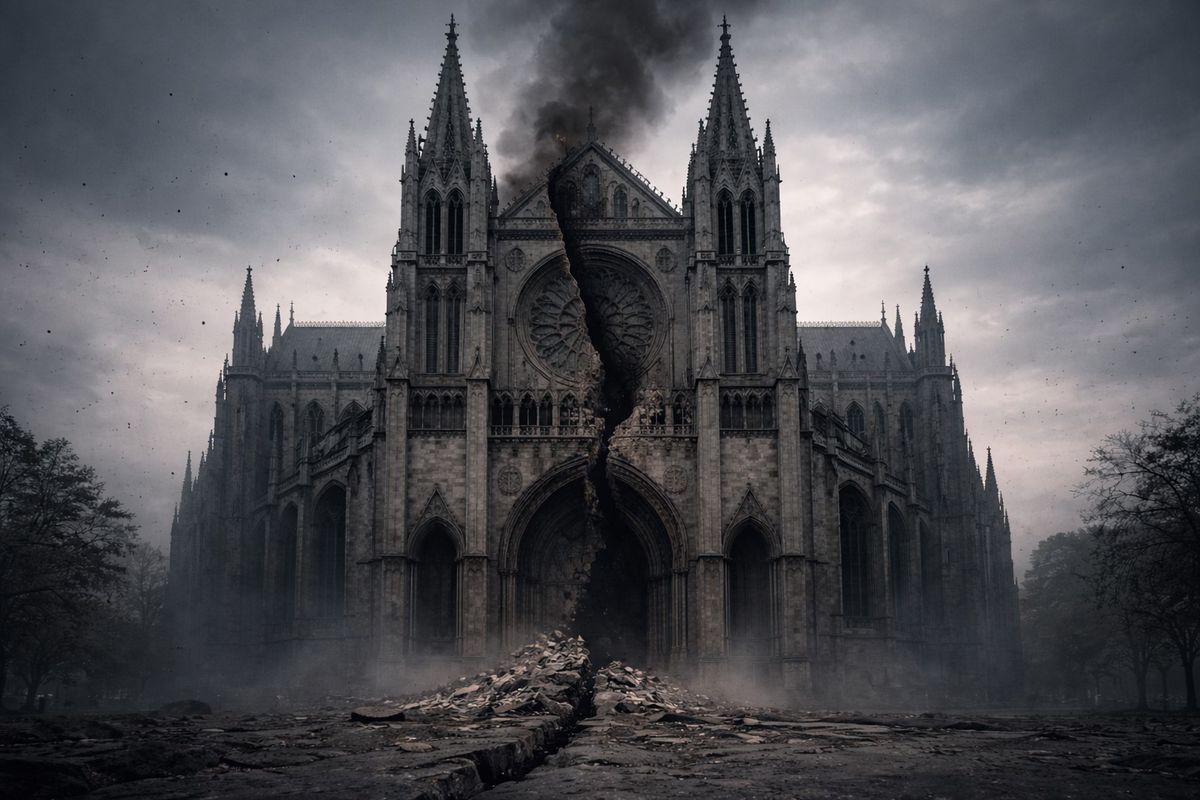
And that is exactly how mature decline looks. The schools still hand out degrees. The courts still issue opinions. The churches still hold services. The government still sounds official. The forms remain. The animating force drains out.
Careerism replaces vocation. Branding replaces conviction. Sentiment replaces standards. The whole culture becomes afraid to say that some things are better than others, that rigor matters, that excellence is expensive, that maturity requires pressure, that softness is not the same thing as mercy.
Reality collects anyway.
The bill always comes. Bridges still have to hold. Code still has to ship. Families still have to function. Children still have to be formed. Borders still have to mean something. Institutions still have to be staffed by serious people. A civilization can spend a long time pretending standards are cruelty. It cannot do that forever and remain intact.
What unsettled me was not that AI said something dark. It was that four different frontier systems, built by four different major labs, all converged on roughly the same answer. Not economics first. Not geopolitics first. Not elections first. Not even war first.
They all pointed deeper.
A civilization collapses when it loses truth, family, discipline, transcendence, and standards.
We know what institutional simulation feels like now. We know what fake language sounds like. We know what it is to live in a world full of tools, entertainment, credentials, and low trust, and still have the nagging sense that the people being formed by it are thinner than the ones who built what we inherited.
That is the actual fear. Not that the West will disappear overnight. That one day it will still be here, still rich, still loud, still technologically advanced, still full of systems and surfaces and consumption, and no longer be able to produce the kind of human being who could have built it in the first place.
That is when collapse is already mature.
Not when the walls fall.
When nobody remembers why they were worth defending.