You Can't Escape the Cost
There is no costless morality.
A camera does not let you cheat reality.
Tighten the diaphragm and the image sharpens, but less light gets in. Open it and the light enters, but the focus softens. The photographer can choose the effect. He cannot escape the trade-off.
That was the image used in the Thomas Sowell documentary I watched, and it stayed with me because it made the argument physical. Sowell's point is not limited to economics. It is about reality. Every decision gives something and takes something. Every policy creates benefits and costs. Every moral claim lands inside a world of incentives, limits, people, and consequence.
The dishonest move is not choosing a trade-off. We all do that.
The dishonest move is pretending the cost is not there.
Earlier that day, an article surfaced in my feed about Oregon's IP28, the People for the Elimination of Animal Cruelty Exemptions Act. Maybe the algorithm was trying to stir me up. Maybe it knew exactly what it was doing. Either way, I read it. Then I went to the source.
The campaign's own website says IP28 would extend the legal protections that keep our companion animals safe to animals currently on farms, in research labs, and in the wild. It also says the measure would protect those animals from slaughter, hunting, fishing, and experimentation. (https://www.yesonip28.org/about)
I started with fishing because fishing is not abstract to me. I love trout fishing. I love fly fishing. Since I was a kid, I have held a clear moral line around wild trout. A native trout should be caught carefully and released. A farmed trout is a different matter. That distinction was drawn for me early, and I still believe it is right. Protect the native fish. Respect the river. Do not take what should be returned.
There is something beautiful about holding a wild rainbow trout in your hands. It is alive, cold, bright, and stronger than it looks. You feel the weight of it for a few seconds. You see the color. Then you put it back in the water and let it disappear.
That is ethical. That is moral. It is one of the cleaner ways human beings can participate in nature without consuming everything they touch.
Oregon's animal cruelty statutes, ORS 167.315 through 167.333, currently exempt lawful fishing. IP28 strips that exemption. Animal abuse in Oregon is the intentional, knowing, or reckless injury of an animal, and a hook injures the fish. Remove the exemption and the careful release becomes the crime.
So the trout goes back into the river alive, but the man who caught it may have committed one.
That did not make me want to rant.
It made me start counting.
I love animals. I grew up with dogs. I love wild places. I love birds. For a season of my life I was deep into birding, and some of the most beautiful things I have ever seen were not soft.
Once I watched a red-tailed hawk dive into a field and come up with a mouse in its talons. The hawk lifted off and started moving across the sky. Then a peregrine falcon came from above, fast and violent, and hit the hawk hard enough that the hawk dropped the mouse. The mouse started falling through the air. Maybe 30 feet below the hawk, the falcon took it mid-drop and was gone.
Nature did not ask me to approve. It showed me what it was.
Nature is beautiful, but it is not sentimental. It is ordered, dangerous, alive, and full of death. Anyone who has spent real time watching animals knows this. The natural world is not a children's book. It is not a sanctuary where nothing bleeds. It is a world where life feeds on life, where predation is not moral failure, and where death is woven into the system itself.
Cruelty is not the same as predation. One corrupts the man. The other is just nature doing its work. A decent society should not be casual about suffering. A hunter, rancher, fisherman, or eater should understand the gravity of what is being taken. Many cultures understood this better than modern people do. They had rituals, seasons, restraint, and gratitude because they knew food was not detached from death.
But this is exactly where Sowell matters.
His frame drags the argument back to the floor. Compared to what. At what cost. Who pays. What breaks when this works. Those questions are not cruel. They are the beginning of seriousness.
Look at IP28 through the Sowell lens and the question changes.
What are the costs of your morality?
Who pays when your moral concern becomes law?
The pest-control piece alone should stop people cold. Multnomah County says rodents are a public-health problem because they spread disease and damage property. The county gives guidance on rat control and distributes snap traps. (https://multco.us/info/rats)
So what happens when the animal is a rat in a Portland wall?
If a rat is chewing through wiring, spreading disease, and living near children, does the family still come second? If not, then the principle is not absolute. If yes, then the principle is deranged.
Oregon may be asked to decide that animal protection should stand above practices that have shaped this state for generations. Fine. A society can choose that ranking. But it should say plainly what it is choosing.
Oregonians have been ranching for generations. Oregon was not built by people who experienced land as an idea. It was built by people who worked it. Families came here to farm and ranch, to sell to farmers and ranchers, and to build lives around soil, livestock, weather, and work. The state was built as an agricultural economy. The people who came here after the 1840s came to work the land, or to supply and serve the families who did. (https://www.ohs.org/blog/oregon-century-farms-and-ranches.cfm)
That is not nostalgia. That is history.
Oregon does not get to enjoy the romance of the West while treating the people who carried its actual labor as disposable.
If Oregon makes livestock processing legally impossible or practically unworkable inside the state, people will not stop eating meat. Restaurants will not stop serving beef. Grocery stores will not stop stocking chicken. The demand will move. Cattle may be raised here and shipped somewhere else to be processed, then shipped back. Or Oregon will simply buy more meat from Idaho, Washington, California, or farther away.
That does not eliminate the cost.
It exports it.
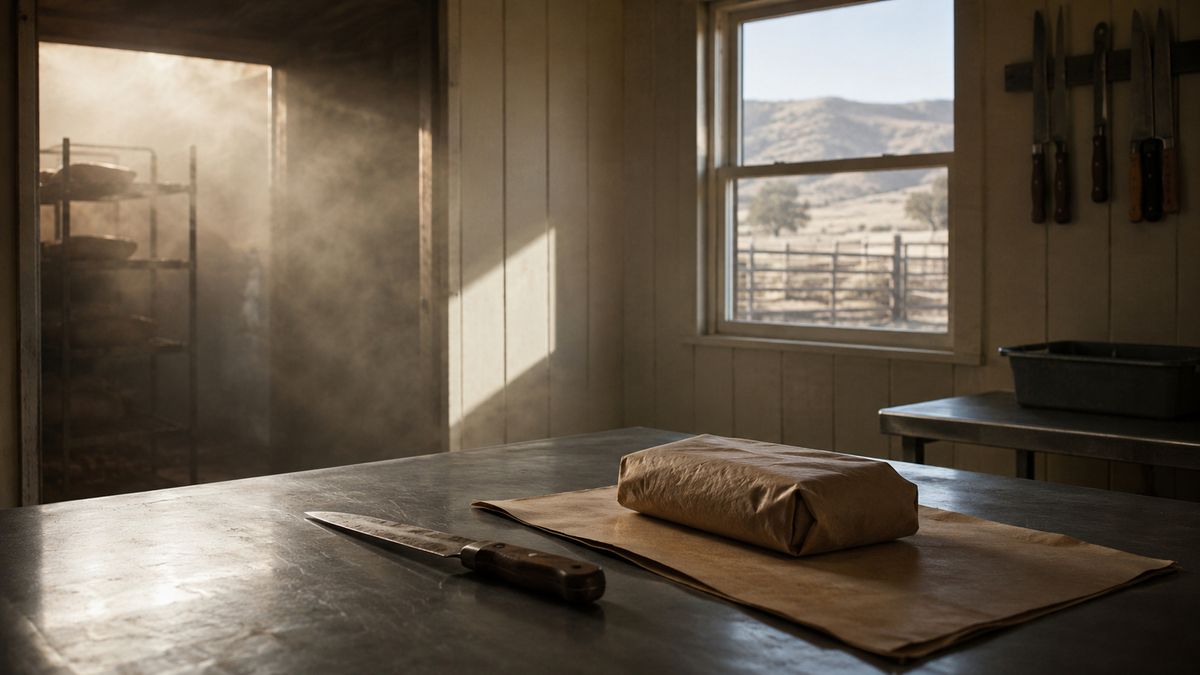
There is a place in Sisters called Sisters Meat and Smokehouse. If you live around Central Oregon, you know the kind of place. Fresh cuts. Smoked meats. Jerky. Sandwiches. People who know what they are doing with a knife, a smoker, and an animal. A real business in a real town, built around craft, sourcing, service, and the simple fact that human beings eat.
Behind a place like that is a whole world most ideology never sees. A rancher checking a fence line after snow. A butcher at a cold counter before sunrise. A smokehouse that smells like work. These are people carrying knowledge the rest of us depend on while pretending we have outgrown it.
The people closest to the land are the last ones listened to when land becomes a political symbol.
That is the part I cannot get past. A morality can be judged by what it protects, what it sacrifices, and what it refuses to count. If your compassion for animals requires you to treat human livelihoods, rural families, and inherited knowledge as acceptable collateral damage, then the problem is not that other people lack compassion. The problem is that your compassion has lost its order.
A morality that elevates animal protection above human beings has taken a true concern and made it ultimate. Once any partial truth becomes ultimate, it starts demanding sacrifices it has no right to demand. Look at what it is willing to break, and decide for yourself what to call it.
The campaign behind it does not expect to win the first time. It says so. The plan is to keep coming back until the answer changes. So this is not a single vote to wait out. It is a question that will be asked again and again until people answer it on purpose.
You can choose that. A state can choose that. Voters can choose that.
There is no costless morality. There are only costs we admit and costs we hide.