Ten Predictions for the Agentic Age
What I think the world looks like by June 1, 2036
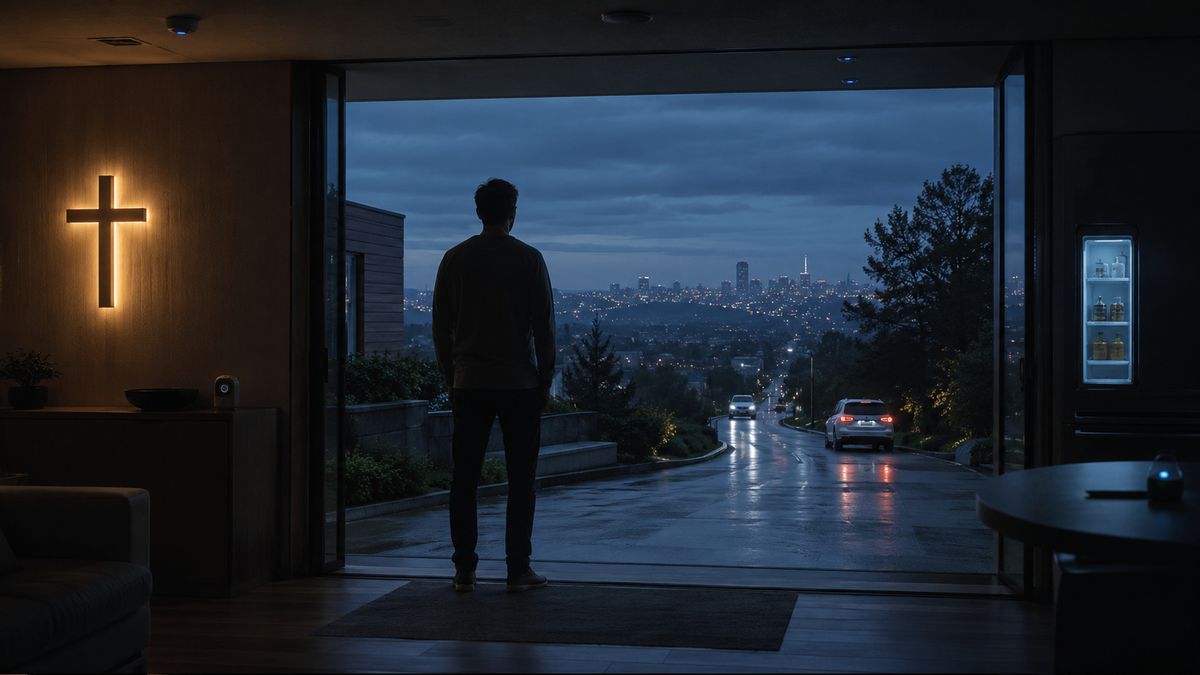
By June 1, 2036, AI will sit between intention and action.
That is the shift. Not smarter chatbots. Not better autocomplete. AI becomes the layer that routes, decides, buys, builds, and acts. It moves through software first, then into the physical world. Most people will not experience this as science fiction. They will experience it as less friction.
The question in 2036 will not be whether people can access intelligence. They will. The question will be whether they can command it.
Underneath that is the harder question. Can human beings govern themselves while commanding power previous generations could not imagine? That is the part most of the AI conversation still avoids. The conversation is obsessed with capability and weak on formation. Intelligence is becoming abundant. Wisdom is not. The agentic age will not only test our tools. It will test what kind of people we have become.
1. The Interface Disappears
Apps will still exist, but people will stop operating them directly. Today, we still use software like clerks. Open Gmail. Open Calendar. Open Uber. Search, tap, compare, confirm, repeat. Every task gets chopped into manual movements across systems that do not really understand the outcome we want.
That workflow is going away because the agent becomes the interface. You tell it what you want done, and it moves across the software layer for you. It books the trip, schedules the meeting, drafts the reply, pays the bill, and remembers the preference for next time. The apps become plumbing. They still matter, but the human being is no longer forced to touch each one by hand.
That sounds like convenience, but it is also power. The interface is not a neutral place. It decides what options appear, what order they appear in, what defaults are set, and what friction remains. Whoever controls the agent layer gets between human desire and market action. In the app age, companies fought to own the screen. In the agentic age, they will fight to own the path between intent and execution.
The app does not die. The tap does.
2. Your Agent Knows Everything
The phone will not disappear, but the rectangle will stop being the center of daily computing. The agentic age moves computing into the environment itself. You will ask instead of tap. Your agent will know the calendar, the route, the meeting, the errand, the thing you keep forgetting, and the thing you are about to need.
For the people who adopt this deeply, the agent will know almost everything. Cameras and monitors in the home. Earpieces and glasses and wearables. Sensors tracking payment, location, sleep, and movement. The point is not one device. The point is continuous context.
You will walk down the street and say, "I want a sandwich." Your agent will know where you are, what you like, what you ate earlier, how much time you have, and which place nearby is actually worth it. You will decide you want dinner, and your agent will talk directly to the restaurant's agent and book the table. You will run low on groceries, and your agent will already know what is in the fridge. If you give it permission and a card, food will show up before you run out.
I want that in my health. I want to know when my blood sugar is moving the wrong way. I want to know when my sleep debt is catching up. I want to know when I need water, food, movement, or rest before the body has to shout. The body is not a side project. It is the infrastructure carrying the life.
But the cost is real. A phone can be put in another room. An environment is harder to leave. Once intelligence is ambient and bodily, mediation becomes constant. The same system that reduces friction can also reduce direct contact with reality.
Technology stops being something you open. It becomes something you live inside.
3. Intelligence Becomes Utility
People will keep arguing about whether the systems are "real AGI," but the economy will not wait for that argument to end. By 2036, high-level cognitive work will be cheap enough that the old premium on intelligence breaks across large parts of the labor market. Research, coding, analysis, writing, and design will be available on demand.
Expertise still matters because reality still punishes amateurs. Bridges have to hold. Bodies should not be cut open by someone pretending a chatbot makes him a surgeon. Code still has to run. Courts still have consequences. But access to intelligence stops being rare enough to protect people, and that will disorient the smart class.
For a long time, intelligence gave people status. It gave them professional safety. If you were the person who could write the memo, build the model, draft the plan, or synthesize the room, you had leverage. Now a model can produce a passable version of that work before lunch.
So the premium moves to judgment, taste, verification, and execution under pressure.
Being smart will still matter. It will not be rare enough to save you.
4. Fluency Becomes Class Structure
When intelligence becomes utility, the divide moves from access to fluency. The next class divide will not be mainly college versus no college, white collar versus blue collar, or smart versus not smart. It will be fluent versus non-fluent.
AI fluency becomes the new literacy. The fluent learn how to use agents, build workflows, verify outputs, and decide which tools belong where. Their reps compound. They get faster every month because they are learning the operating environment while everyone else is still deciding whether it matters.
The non-fluent fall behind in a different way. They become dependent. That is what literacy did. A person who could not read was not stupid, but he needed someone else to read the contract, interpret the law, and move through the systems that governed his life. Text became infrastructure. Literacy became direct access.
AI fluency will work the same way. The fluent person can test an idea, start a company, analyze a contract, learn a field, and move through complexity without waiting for permission. The non-fluent person waits, and that waiting becomes expensive.
AI illiteracy will not make people stupid. It will make them dependent.
There will be another path, but it has to be honest. Some people will reject the agentic layer for moral, spiritual, environmental, or social reasons. Some of those reasons will be serious. But refusing AI will not be like refusing social media. It will be closer to refusing electricity after the grid came online. It will be closer to refusing to light a fire while standing in the cold.
You can do it. But do not lie about the cost.
In ten years, the phone will be agentic. The laptop will be agentic. Search, banking, health, education, work, government services, and commerce will be agentic. Refusing AI will not mean refusing one app. It will mean refusing the operating layer of ordinary institutional life.
If a person wants to live outside that layer, he will need a life built closer to the ground: land, trades, repair, farming, physical care, and embodied community. That can be honorable. It may even become more attractive as the digital world gets stranger.
What will not work is pretending to opt out while remaining dependent on the systems AI now mediates. You can reject the whole apparatus and build a life with fewer claims on it. You cannot reject it, stay inside AI-mediated institutional life, and expect the old rules to protect you.
Refusal is not a strategy unless the life underneath it can carry the cost.
5. Driving Becomes Optional
My daughter is 10. My son is 12.
I do not think either of them will ever have to drive if they do not want to. Frankly, I do not want them to. Driving is one of those things we treat as normal because we inherited it, not because it is sane. We put human beings in heavy steel, send them into traffic at high speed, and then act surprised when fatigue, distraction, ego, and small mistakes kill people every year.
Humans make mistakes. That is not an insult. It is reality.
Autonomous systems will become better drivers than people because driving is exactly the kind of task they should eventually dominate. Constant perception. Fast reaction. No texting. No rage. No fatigue. No looking down for two seconds and drifting across a lane. One autonomous vehicle is useful. Many autonomous vehicles coordinating together becomes a different road system.
The insurance market will force the issue. Actuarial tables do not care about nostalgia. If autonomous vehicles become materially safer than human drivers, insurance pricing will eventually reflect that. Human driving may not be banned by 2036, but I think it becomes increasingly optional and increasingly expensive. The riskier driver pays more. At scale, the human is the riskier driver.
This changes more than commuting. Food delivery booms. Grocery delivery becomes normal. Autonomous vehicles move goods all day. You go to the store because you want to, not because you have to. DoorDash, Uber Eats, and Instacart become larger, more automated, and more tightly connected to the agent layer. Your agent knows what you need. The vehicle brings it. The errand disappears.
People will still drive for pleasure. Fine. People still ride horses. But transportation as necessity moves toward autonomy.
The road gets safer as fewer humans touch the wheel.
6. Every Job Gets Pressured
I do not think this stops at the obvious jobs.
I think every job gets pressured.
Not equally. Not all at once. Not in the same way. But the direction is clear. If a task can be described, observed, repeated, simulated, or decomposed, automation is coming for it. First as assistance. Then as partial replacement. Then as default execution with a human watching the exceptions.
White-collar work gets hit because language, analysis, code, and planning are becoming machine-native. Blue-collar work gets hit later because atoms are harder than text, but later is not never. The physical world is slower, but it is not safe.
Even surgery will not be exempt. The average surgeon is not safe because the work is sacred. He is safe only where his judgment, dexterity, and complication-management still exceed the system. Routine procedural work will be pressured. So will diagnostics. So will planning. The human may remain essential in the hardest cases, but the protected zone keeps shrinking.
The comforting story is that humans will keep the judgment jobs, the care jobs, the creative jobs, the leadership jobs. Some will. But even those jobs will be surrounded, compressed, and repriced by systems that do more of the surrounding work for less money. A human may still matter. The question is whether the market needs five humans, one human, or none.
By 2036, most work will have to justify why a human is still in the loop.
That does not mean humans are worthless. It means labor stops being the default answer.
7. The State Is Forced to Respond
This is the section that cuts hardest against my instincts.
My economic instincts are much closer to Milton Friedman, Friedrich Hayek, and Thomas Sowell than to state-managed economic engineering. Free markets matter. Incentives matter. Prices carry information no central planner can hold. Responsibility belongs as close to the person, family, business, church, and local community as possible. Government usually solves less than it promises.
So when people start talking about universal basic income and automation taxes, my first instinct is resistance.
But this transition may force a different short-run answer. If firms can produce more with fewer people, they will automate because the incentive will be too strong. That is not because executives are evil. It is because the market will punish the firm that keeps expensive human labor when competitors automate the same task cheaper, faster, and more consistently.
In the long run, Friedman, Hayek, and Sowell still rule the day. Incentives still matter. Knowledge is still dispersed. Government still fails in predictable ways. But in the transition, Keynes gets a vote. When displacement hits faster than people can adapt, demand, income, political stability, and social order become live problems. You do not get to wave those away with elegant long-run theory while the short run is breaking people in front of you.
Universal basic income may become necessary as a temporary floor. It may keep people from falling through the bottom. It may soften the landing. But universal basic income is not enough because it does not change the firm's incentive to automate. It pays people after the displacement has already happened. It does not touch the decision itself.
Automation tax is different. It hits the margin where the decision is made.
If automation creates a social cost that the firm does not bear, then policy has to meet the decision at the point of substitution. Otherwise each firm captures its own savings while spreading part of the damage across the broader economy. Voluntary restraint will not hold. In a competitive market, the firm that refuses to automate on moral grounds gets punished by the firm that does not.
So yes, I think automation tax becomes the serious policy answer.
It is not clean. Firms will fight over what counts as automation, and capital will move toward whatever jurisdiction taxes it least. Any honest version has to survive that gaming, or it just exports the decision instead of meeting it. But the alternative is pretending the incentive does not exist, and it does.
Not because government is wise. Not because taxation is magic. Because incentive design matters.
Universal basic income treats the aftermath. Automation tax changes the calculus.
But money is still only the first layer. Work has been one of the main distribution systems for identity. It gives people income, but it also gives them structure. A role to play. A way to be useful. A way to measure themselves against reality. If that structure weakens, politics gets uglier.
The state will try to stabilize the economic part. It will not know how to replace the formation part.
8. Robots Enter the Physical World
The labor shock begins in software, but it does not stay there.
Robots are not a distant cartoon. They are being trained right now. Human beings are wearing headsets, camera rigs, and control systems so machines can learn how bodies move through physical space. That matters because robotics is not only about one robot doing one task. It is about the data flywheel. Every demonstration, every teleoperated movement, every correction becomes training material.
Once robots are deployed widely enough, they do not only perform labor. They generate the data that trains the next generation of labor. That is why I think the physical world moves faster than people expect.
Atoms are harder than text. Fine. That remains true. A robot does not get to hallucinate while carrying an old woman to the bathroom. But the direction is obvious. These systems will move from warehouses and factories into farms, hospitals, construction sites, restaurants, streets, and homes.
By 2036, robots will not do one narrow category of work. They will do whatever they can be trained to do cheaply enough.
If the economics work, the robot moves in. If the robot moves in, the human role has to justify itself.
The first agentic age happens in software. The second walks into the room.
9. The Body Becomes an Interface
The next boundary is the body.
Wearables are the beginning. Implants are coming faster than most people think. The first serious market is restoration: paralysis, neurological disease, injury, sensory loss. That moral case is strong. A paralyzed man moving a cursor with his mind is not a gimmick. It is restoration.
But restoration will not stay contained.
Once the interface works, enhancement follows. People will have to decide whether they want increased cognition, tighter integration with their agent, faster communication, or some form of always-on connection to their AI. This will not feel like science fiction by 2036. It will feel like the next edge.
The real pressure will not be that some people choose enhancement. The pressure will be that competitive environments make enhancement feel mandatory. If a surgeon, soldier, founder, or student can gain an edge by integrating more tightly with these systems, the choice stops feeling private. It becomes a status contest, then a professional expectation, then a new baseline.
The Christian frame matters here because the body is not disposable hardware. Human beings are made in the image of God. We are not software trapped in meat. We are embodied creatures. The body is not an accident to overcome. It is part of what we are, and it has been entrusted to us. Medicine is good. Restoration is good. Healing is good. But a culture that sees the body only as a platform will eventually treat human nature itself as an engineering problem.
Healing is one thing. Upgrading is another.
The body stops being treated as a hard boundary. It starts being treated as hardware.
10. Longevity Escape Velocity Comes Into View
Aging will stop being treated as fate.
I am not saying entropy disappears. It does not. Every system runs down. Disorder still has to be fought. The body still breaks. Biology still collects. Death is not defeated by slogans.
But the rate of progress matters.
Longevity escape velocity is the point where medicine extends remaining life expectancy faster than time passes. One more year lived, more than one year of healthy life gained. That is the threshold. We are not there yet, but AI changes the slope by accelerating biology, diagnostics, simulation, drug discovery, and personalized intervention.
My bet is that by 2036, we are much closer than most people think.
We may not be at escape velocity. We may be close. We may even be there in the stretch case. But the important point is that the cultural meaning of aging changes once serious people believe the slope is bending. Aging stops feeling like a fixed sentence and starts looking like an engineering target.
That will bring enormous good. More fathers seeing grandchildren. More mothers avoiding disease. More time with the people we love. More years to build, repair, repent, create, and serve. I want that. I am not going to pretend longer healthy life is some dark thing just because it will create hard problems.
But it will not arrive evenly. The wealthy will get access first. That means more years to build wealth, hold power, and control institutions. Wealth already compounds. If time compounds too, the upper class gets a second engine.
Lifespan inequality will not feel like normal inequality. It will feel metaphysical.
People can tolerate unequal luxury. Unequal time is harder.
The Final Bet
The ten predictions are the machinery. This is what the machinery reveals.
If AI and robotics reduce the need for human labor, the crisis will not be mainly technical. It will not even be mainly economic. Governments will fight over the economic part. They will tax, subsidize, regulate, and invent new language for old political battles. The deeper crisis is spiritual.
Work has given people structure for generations. It has given them a reason to wake up, a role to play, a way to provide, and a way to measure themselves against reality. Necessity has been brutal, but it has also formed people. When necessity weakens, people do not automatically become free. A lot of them drift.
That does not mean abundance is bad. It is good when disease is treated earlier, dangerous labor is reduced, parents get more time with children, and people are freed from work that crushes the soul. The upside is real. I want more human capability, not less.
New work will appear. New vocations, new crafts, new forms of family and church life and local production will emerge that I cannot predict from here. Some people will adapt beautifully. They will build, teach, heal, steward land, raise children, and form communities stronger than the ones we have now. That is part of the hope.
But new possibility does not remove the need for formation. It increases it.
Abundance does not automatically form the person. Comfort does not answer what life is for. The system can remove friction, but it cannot give man a reason to become serious. It cannot make him faithful. It cannot make him courageous. It cannot make him love what is good.
This is where my Christian faith becomes central. Not decorative. Central. Christianity gives me the anthropology I think this age requires. Human beings are not productivity engines. We are not upgradeable software objects. We are not appetite with tools. We are creatures made by God, accountable to God, embodied before God, and called to love God and neighbor.
That matters more in the agentic age, not less, because once capability explodes, formation becomes the scarce thing. Power without wisdom becomes dangerous. Intelligence without morality becomes scalable disorder. Agency without submission becomes appetite with better tools. I am ambitious. I want to build. I want to win. I am using these systems as hard as I can. But automation is not my God. AI is not salvation.
It cannot tell man what he is for.
It can generate options. It can build the first version. It can make the plan, write the code, book the trip, choose the route, and tell you what is most efficient. But it cannot decide what should be loved. It cannot tell a father what he owes his children. It cannot tell a founder when ambition has become worship. It cannot tell a civilization what is sacred after it has trained itself to treat everything as an input.
That is where the next age will expose us. Not in the demos. Not in the product launches. In the ordinary places where character either holds or breaks. In the home. In the body. In the church. In the company. In the quiet moment after you are handed exactly what you asked for and you still have to decide whether what you asked for was good.
It will not save us from ourselves. It will scale what is already there.
The lazy will have better excuses. The ambitious will have sharper tools. The disordered will scale disorder. The governed will build things that last.
The age belongs to people who can command these systems because they are not commanded by appetite.