The Crisis After Abundance
What happens when necessity gets removed faster than man learns how to live without it?
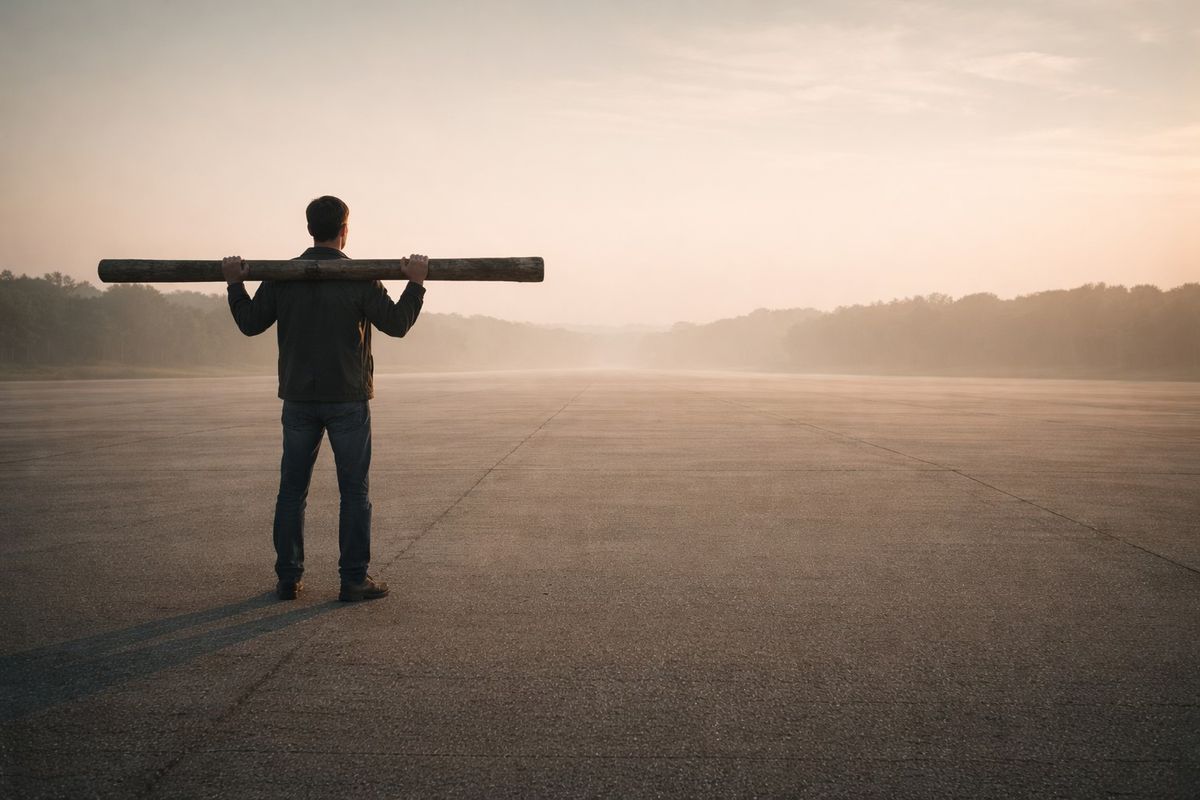
I do not get weaker when I am carrying a real load. I get weaker when there is nothing worth carrying.
When I am building, I get better. I get sharper. More disciplined. The day tightens up. Time matters again. Decisions matter again. There is something to solve, something to build, something to carry that asks more of me than comfort ever will.
That is why I have no patience for the fantasy that the human dream is a life with less burden.
Most people do not need less burden. They need a burden worthy of them.
For most of history, necessity supplied one. You had to work. You had to provide. You had to solve what was in front of you. The roof leaked. The child needed food. The field needed work. Reality did not care whether you felt inspired. It just kept making demands.
That kind of pressure could be brutal. But it did something modern people still do not talk about honestly. It organized the person.
Work was never just about income. It gave shape to the day. It forced movement. It demanded attention. It gave people proof they were useful. It gave them a reason to get out of bed before they had any grand theory about meaning.
And because of that, necessity covered a lot.
If you are needed enough, tired enough, behind enough, and busy enough, you can go a long time without asking deeper questions. You can confuse motion with meaning. You can mistake obligation for purpose. You can call survival a life and never notice the difference.
Now we are moving into a world where some of that old structure may start thinning out. Not all at once. Not for everyone. But enough to matter.
AI and automation are beginning to reduce the amount of human labor required across more domains than most people understand. The first conversation is always economic. Jobs. Wages. Productivity. Displacement. Fine. That is real.
But I do not think that is the deepest problem.
The deeper problem is what happens when fewer people are required by necessity to carry real weight. Because a man without a worthy burden does not automatically become free. He can just as easily become soft.
That is the lie underneath a lot of abundance talk. People act like remove enough friction and human beings will naturally rise. They will create more. Think more. Live better. Become more fully themselves. Maybe some will.
A lot of others will just drift.
Most people do not want freedom from work. They want freedom from bad work. They want freedom from bureaucracy, pointless labor, fake urgency, and all the dead machinery that eats up life without giving any back. That is a fair complaint. I understand it.
But relief from bad work is not the same thing as being prepared for a life no longer organized by necessity.
Remove the pressure and you do not automatically get greatness. Sometimes you just uncover the vacuum underneath.
The old emptiness does not disappear in that world.
It just gets better furniture.
That decline does not usually look dramatic. It looks small at first. A man gets softer in the soul. More distracted. Less capable of sustained effort. Less willing to do hard things that do not pay off immediately. His appetite for difficulty starts shrinking because more and more of the world around him is built to remove it. The answer arrives faster. The system delivers faster. Stimulation gets cheaper. Entertainment gets better. More of life starts arriving on demand.
That is the part that stays with me. Material ease does not solve the human problem. In some cases it reveals it more clearly. If survival stops being the main force organizing life, a man is left facing himself more directly than before. What he wants. What he worships. What he does when nothing outside him is forcing him into form.
A lot of people are not going to like what they find.
Because the issue was never just labor. It was always meaning.
You can give someone more access, more options, more comfort, more entertainment, and still leave him hollow. You can remove half the friction from daily life and still leave him with no serious answer to the question of what his life is for. In fact, if there is nothing higher governing him, abundance may make the problem worse. He now has more ways to avoid himself, more ways to numb himself, and fewer external structures forcing him to become anything at all.
That is not liberation.
That is decay with a nicer interface.
That is why I think the real crisis after abundance is spiritual.
If man is no longer forced to survive, he is forced to confront himself. He has to answer what orders his life when survival is no longer the main event. What disciplines him then. What tells him what matters. What keeps him from collapsing inward into appetite, vanity, amusement, and drift.
For me, that lands in a Christian place because faith is not decoration. It is structure. It is what tells a man that his life is not his own, that comfort is a terrible god, and that ease is not the measure of a good life. It is what tells a father that if the world stops demanding much from him, he still owes his children discipline, presence, and an example worth inheriting. Abundance cannot give them that. A man has to choose it, and he has to choose it under God.
A world with more convenience, more output, more access, and more synthetic satisfaction may also become a world with less reason to become serious, less reason to sacrifice, and less reason to submit yourself to anything higher than preference. When necessity gets removed, its removal also exposes whether there was anything underneath it. Any real structure. Any real worship. Any real reason to carry a life with discipline when no one is making you do it.
That is the crisis after abundance.
Not that people will have too little.
Survival was the scaffolding, not the point.