The Gap Is Widening By the Day
I do not want to sleep. I stop because I have to.
I was sitting at a brewpub in Bend talking to smart, capable adults when the conversation turned to AI.
I asked whether they used it.
Nine out of ten said some version of the same thing. I do not use it. I do not need it. I do not want it.
I felt afraid for them.
Not annoyed. Afraid.
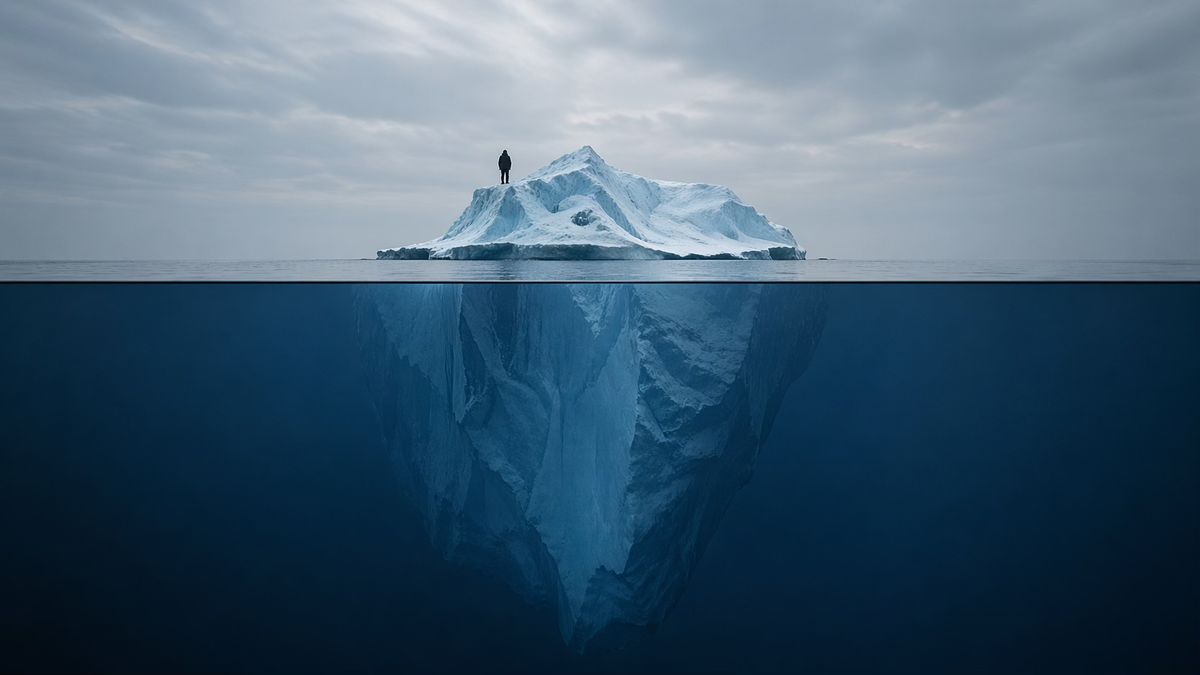
Because in January, I was one of them. I knew enough to be dangerous. I could think in systems. I could use an AI as a thought partner. I could see that something big was happening. But I was still standing at the tip of the iceberg, looking at the little bit above the water and thinking I understood the shape.
I did not.
Then I spent 60 days working 16 to 18 hours a day doing almost nothing but building. Repos. Terminals. Agents. Code. Debugging. Shipping. I kept going down the slope of the iceberg until I hit the waterline and realized the real mass was below me, hidden, cold, and enormous.
I do not want to go to bed anymore. I stop because I have to. I sit in the chair because the results are intoxicating. An agent reads a repo and comes back with exactly what I needed. A workflow I would have paid an employee to run three years ago executes itself while I watch. A problem I would have chewed on for a week collapses in an afternoon. Dopamine hits all day. It is the most alive my work has felt in years.
That is what the people at the brewpub cannot picture.
They think this is a better search box. A smarter autocomplete. A clever assistant sitting off to the side.
That is the shallow end.
The real shift is what happens when these systems stop acting like passive tools and start acting like infrastructure. When work becomes conversational, iterative, and live. When the system is not just answering questions, but reading context, routing information, drafting actions, and collapsing layers of friction that used to eat whole days.
I was talking to someone the other day and realized they did not even know what an agent was.
That stopped me cold.
Because how do you explain the size of the change to someone who does not even have language for the object yet.
How do you explain the moment when your inbox stops being a swamp you slog through manually because the system has already read it, organized it, surfaced what matters, and handed you a clean briefing before the day starts.
How do you explain the moment when you stop touching a CRM the old way because the system is already pulling context, tracking follow-ups, and handling the dead administrative middle that used to drain your attention.
And access is no longer the hard part. Access is the easy part now. The hard part is judgment.
Anybody can touch power now. Far fewer people can direct it.
Signal from noise. Real workflow from dead end. The thing worth building from the thing that should be shelved immediately. That is the work now.
I have already tried things that did not work and shelved them. I have already gone down roads that looked promising and turned out to be bullshit. That learning matters. Because discernment is now part of execution.
The people entering this world today are not just learning tools. They are learning how to decide inside abundance.
The gap is already wide.
One side is getting reps. Real reps. Pattern recognition. Error recovery. Speed. Fluency. The other side is still debating whether this deserves their attention.
I feel behind, and I am on top of this.
Because if I can spend two months going all in and still feel the ground moving beneath me, what exactly is the position of the person who still thinks this is optional. The person who says they will get to it later. The person who thinks this is mostly for coders, or kids, or startup people in San Francisco. The person who thinks experience in the old world will buy enough time to ease into the new one.
It will not.
What is happening right now is not a faster version of the old workflow. It is a new operating environment. The difference is not mortar and pestle to Cuisinart. It is candlelight to electricity.
Once electricity shows up, the question is no longer whether the candle still works. The question is what kind of person keeps lighting candles as the grid comes online.
The fear is not about technology. It is about watching people I care about misread a structural break in real time. People with responsibilities. People with children who will inherit whatever world this becomes. They are not stupid. They are just living normal life while the floor is moving under them.
I am building multiple companies right now with no engineering team, no product manager, and no designer. Two years ago, that was not a real option.
And this does not stop at work. That is too small a frame.
This is about stewardship.
If you are a father or a provider with people depending on you, you do not get to treat a capability shift like this as trivia. You do not get to wave it off because it feels technical or unfamiliar or embarrassing to learn. The world is repricing what one person can do. That changes what you owe the people in your care.
Faith matters here for me because it keeps the argument from collapsing into career panic. This is not about becoming more optimized so I can worship output harder. It is about seeing what is happening clearly and carrying that responsibility honestly. Talent is not enough. Experience is not enough. Intelligence is not enough. If God gives you eyes to see a shift that matters, pretending not to see it is not humility. It is negligence.
The separation is already happening, and most people are still talking like the iceberg ends at the surface.
It does not.
The people still arguing about whether to start are not preserving anything.
They are standing at the tip, in street clothes, talking about weather, while the ice beneath them keeps moving out to sea.