The Universe Is Not an Accident
The deeper you inspect reality, the less accident looks like an answer and the more it looks like an evasion.
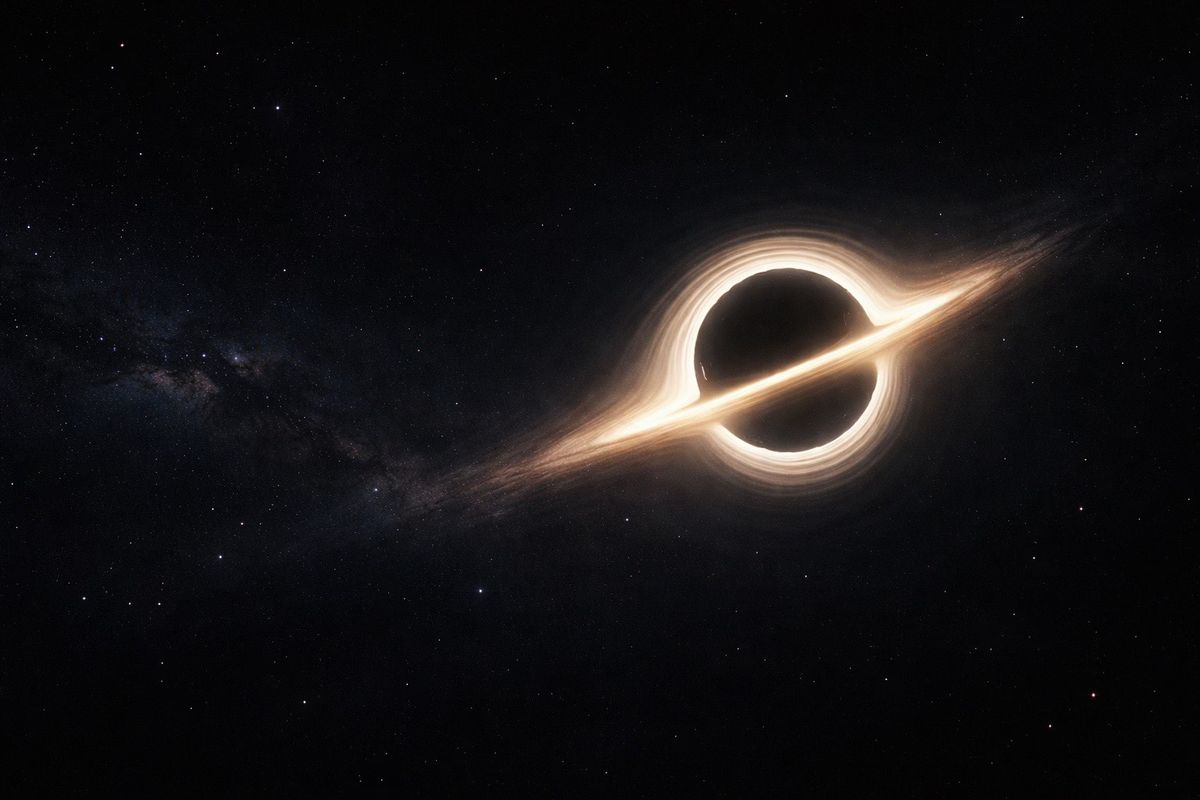
The universe had to get too much right.
That is where this starts for me. Not in sentiment. Not in vague wonder. Not in the cheap version of faith where someone looks at the stars, feels small, and mistakes that feeling for theology. I mean structure. I mean built-in conditions. I mean a reality that had to arrive with extraordinary precision before anything else could happen at all.
I am not a physicist. I am a founder. I think in systems, dependencies, constraints, and failure modes. I think about what has to be true upstream for anything downstream to work. I think about what breaks when a variable moves too far. I think about narrow tolerances and hidden load-bearing conditions. When I look at the universe that way, I do not see a rough system that somehow got lucky. I see a reality that had to arrive inside a very narrow band of possibility before there could be stars, chemistry, planets, bodies, minds, language, judgment, or the question of God at all.
That matters because the modern reflex is to treat existence as the baseline and explanation as optional. The universe is here, so people talk as if the burden has already been carried. As if a law-governed, intelligible, life-permitting reality is the default case and faith is what needs defending. I do not think that is intellectually serious.
Reality runs on built-in settings. Call them constants, forces, initial conditions, whatever you want. The point is simple. The world is not just there. It is structured. It runs according to fixed features that determine whether matter organizes, whether stars can form, whether chemistry can hold, whether anything has enough stability and enough time for complexity to emerge. These are not poetic abstractions. They are real features of the world. And they sit inside ranges narrow enough that precision is the only honest word for them.
Take expansion. The universe had to open in a way that let matter gather instead of disappear into dispersion or collapse back into ruin. Too far one way and nothing holds together long enough to build. Too far the other and the whole thing folds in on itself before anything durable can emerge. What we got was a universe that left room for structure, which is what makes the next problem impossible to ignore.
Gravity is astonishingly weak compared with the other forces, and that weakness is not some cute scientific detail people throw in for flavor. It matters. Stronger gravity and stars burn hard and die young. There is no deep runway for complexity to accumulate. Weaker gravity and matter does not gather the way it needs to. You do not get stars in the first place. The gravity we have gives reality time to build, and time is not decorative in a universe like this. It is one of the conditions.
Go one level deeper and the same fragility appears again. Move the force that helps hold atomic nuclei together enough and the chemistry we depend on starts falling apart. The universe does not become a rougher version of itself. It becomes far less capable of producing the kinds of elements life depends on. Carbon becomes a problem. Oxygen becomes a problem. The material basis of living complexity stops looking inevitable and starts looking fragile.
This is where Fred Hoyle becomes difficult to ignore. Hoyle was not looking for God. He was not trying to sneak theology into science. He was an astrophysicist, an atheist, and one of the people most responsible for working out how stars build heavy elements. In the course of that work, he ran into something that should bother anyone paying attention. Carbon formation inside stars depends on a very specific energy match. If that setting sat elsewhere, carbon and oxygen would not be produced in the right way or in the right abundance for life-permitting chemistry to exist. Hoyle reasoned backward from the fact that life exists and concluded that this setting had to be there. Then it was found.
What matters is not just the science. It is what the science forced him to say.
A common sense interpretation of the facts suggests that a superintellect has monkeyed with physics, as well as with chemistry and biology.
That sentence did not come from a preacher. It came from a man staring at the machinery.
Paul Davies, no Christian apologist either, looked at the same body of evidence and reached for the same kind of language. The universe, he said, looks suspiciously like a fix.
That is what interests me. Not that these men became Christians. They did not. It is that the numbers kept pressing thoughtful people toward language they did not want to use, because at some point precision stops feeling like drift. At some point it starts feeling set.
And the settings were not enough on their own. The universe did not just need the right ongoing structure. It needed the right opening state. This is the part that should sober anyone with a functioning mind. A universe that begins in disorder does not climb its way into beauty and complexity for free. It runs down. That is what disordered systems do. The universe we inhabit began in a condition ordered enough that small irregularities could become stars and galaxies over immense stretches of time instead of dissolving into meaninglessness.
Roger Penrose tried to get his arms around how specific that initial condition appears to have been. The number associated with that effort is so absurdly large that even writing it out does not really tame it. It is one in ten to the power of ten to the power of one hundred twenty-three. Not one in ten trillion. Not one in ten trillion trillion. One in ten to the power of ten to the power of one hundred twenty-three. The mind does not hold a number like that. It recoils from it. And that is the point. Penrose was not proving Christianity. He was measuring how specific the opening state appears to have been. That measurement should end the casual confidence with which people say all this just happened.
Just happened is doing more work than most people want to admit.
Because that is what the accident story needs. It needs the settings to have landed inside life-permitting ranges without intention. It needs the opening condition to have been extraordinarily specific without intention. And then it asks to be called the sober position.
I do not buy that.
At this point people usually reach for one of two exits. The first is brute fact. The universe just is. The laws just are. The constants just are. The starting condition just is. No explanation sits underneath any of it, and none is required. But that is not science. Science describes what exists and how it behaves. It does not answer why a law-governed reality exists at all, why the laws are these laws, or why the starting condition of the universe was one of the vanishingly small set of conditions from which structured existence could emerge.
Brute fact is not an explanation. It is where explanation goes to die.
The second exit is the multiverse. Maybe there are infinitely many universes. Maybe every possible combination gets tried somewhere. Maybe ours is just the one that worked, and naturally we find ourselves here because no one would be around to notice the failures. This sounds clever because it sounds expansive. It sounds like a bigger system, and people confuse bigger systems with better explanations. But the multiverse does not solve the problem. It relocates it. Even if you grant some universe-generating framework, you still need an account of the framework itself, what generates it, what governs it, why it exists, and why it has the capacity to produce realities at all.
You have not answered the first question. You have moved it.
That gets to the thing people routinely butcher when they talk about Occam's Razor. Occam's Razor does not mean the shortest sentence wins. It means you do not keep multiplying unsupported assumptions when a more coherent explanation is already sitting in front of you. People talk as if design is obviously the bloated answer and accident is the lean one. But count honestly. The accident story requires a reality with precisely bounded settings, an extraordinarily specific starting condition, and either no underlying explanation at all or some unobserved, infinitely productive meta-structure with its own unexplained rules.
That is not lean. That is a theory held together by things it cannot explain.
The design story requires mind, intention, and agency prior to the system. Design does not keep adding machinery to avoid itself. It does not keep pushing the first question back one layer deeper and calling that rigor. It looks at a universe that appears finely set, law-governed, intelligible, and astonishingly specific at the opening, and it says the obvious thing.
This looks intended.
To me, that is the cleaner explanation. Not softer. Not easier. Cleaner.
The deeper question is not whether science can name the forces or sketch the timeline. It can. The deeper question is why there is a reality here to describe at all. Why there is something rather than nothing. Why a world exists that can be described mathematically. Why laws hold. Why reality is intelligible. Why the structure is there to be read at all. That kind of question does not disappear because someone calls it metaphysics. It just gets heavier.
I am a Christian, so I am not going to play the fake-neutral game. I am not standing outside this pretending to be some floating analyst with no commitments and no stake. I know where I land. But I also want to be disciplined about what I am claiming. Cosmology does not get you all the way to the Gospel. The fine-tuning of the universe does not, by itself, establish the resurrection of Jesus Christ, the authority of Scripture, or the full truth of Christianity. I would never say otherwise. Those claims stand on their own grounds.
But this argument still matters. It clears ground. It exposes the lie that belief in God is what remains after serious thought runs out. No. Sometimes belief in God is what remains after serious thought refuses to lie, after the numbers are allowed to speak, after the machinery is actually inspected, after the cost of the rival explanations is counted honestly.
That is the part I cannot get past. The universe is not rough. It is not casual. It is not the kind of thing that looks as though it stumbled into order and then built a ladder to consciousness by accident. It looks governed. It looks set. It looks like reality arrived under conditions that had to be there before reality could hold.
That does not feel like a slogan to me. It feels like a verdict.
Hoyle saw enough to say more than he wanted to say. Penrose measured enough to make complacency look childish. Davies saw enough to admit the fix. The numbers kept pressing on all of them. They press on me too. I think a lot of modern people feel that pressure and then immediately look for somewhere safe to put it, a bigger abstraction, a more fashionable uncertainty, something thick enough to keep the plain thing in front of them from becoming unavoidable.
I am not interested in that anymore.
At some point, you either follow the structure where it leads or you do not. I do. I think the universe was made on purpose. I think the reason there is something rather than nothing is not because nothing failed. It is because God willed a world into being. I think the settings were set. I think the order is real. I think the mind behind it is real too.
And I know His name.